UAA College of Engineering
Agent-based modeling of killer whales and their prey
A collaborative project led by: Ward Testa, Kenrick Mock, Cameron Taylor, Heather Koyuk, Jessica Coyle, Russell Waggoner
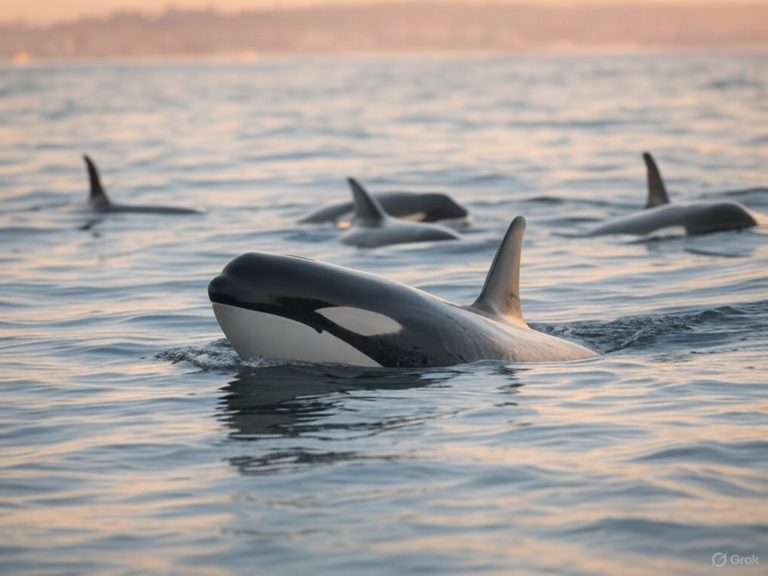


Agent-Based Modeling of Marine Predator-Prey Dynamics: Insights Into Killer Whale Ecosystems
Bridging Ecological Complexity Through Computational Simulation
This research project investigates the role of transient killer whales in Alaska's marine ecosystem dynamics, particularly their impact on declining prey populations. By developing an agent-based model (ABM) that surpasses classical predator-prey frameworks, we reveal intricate ecological relationships obscured by traditional differential equation approaches
The model was calibrated with single-prey scenarios and then extended to multi-prey scenarios, revealing complex dynamics and long time lags that may reveal clues about existing killer whale populations.
The project challenges classical Lotka-Volterra predator-prey models by incorporating:
The model revealed 30-year population oscillation cycles and identified critical thresholds where prey depletion triggers cascading ecosystem impacts.
The model was calibrated with single-prey scenarios and then extended to multi-prey scenarios, revealing complex dynamics and long time lags that may reveal clues about existing killer whale populations.
The project challenges classical Lotka-Volterra predator-prey models by incorporating:
- Individual whale biology: Age, sex, mass, reproductive status, and kinship tracking
- Energetic demands: Field metabolic rates (405.39 kcal baseline) and prey-to-energy conversion efficiencies (85% for prey, 95% for milk)
- Group hunting dynamics: Pod associations and age-dependent hunting effectiveness (full capacity at age 12)
- Multi-prey interactions: Harbor seals, Steller sea lions, and seasonal whale populations
The model revealed 30-year population oscillation cycles and identified critical thresholds where prey depletion triggers cascading ecosystem impacts.
Frequently Asked Questions
Traditional models couldn’t simulate individual whale energetics (e.g., 4,000kg male target mass) or group hunting behaviors critical to transient orca predation strategies.
The model identified:
- Critical prey density thresholds for killer whale survival
- Delayed recovery timelines post-prey collapse
- Milk dependency curves guiding calf survival (logistic a=6.1, b=-0.02)
Model code and documentation remain available at:
http://www.math.uaa.alaska.edu/~orca/
This collaborative project is led by Ward Testa, Kenrick Mock, Cameron Taylor, Heather Koyuk, Jessica Coyle, Russell Waggoner